Built on IRTAmar® technology
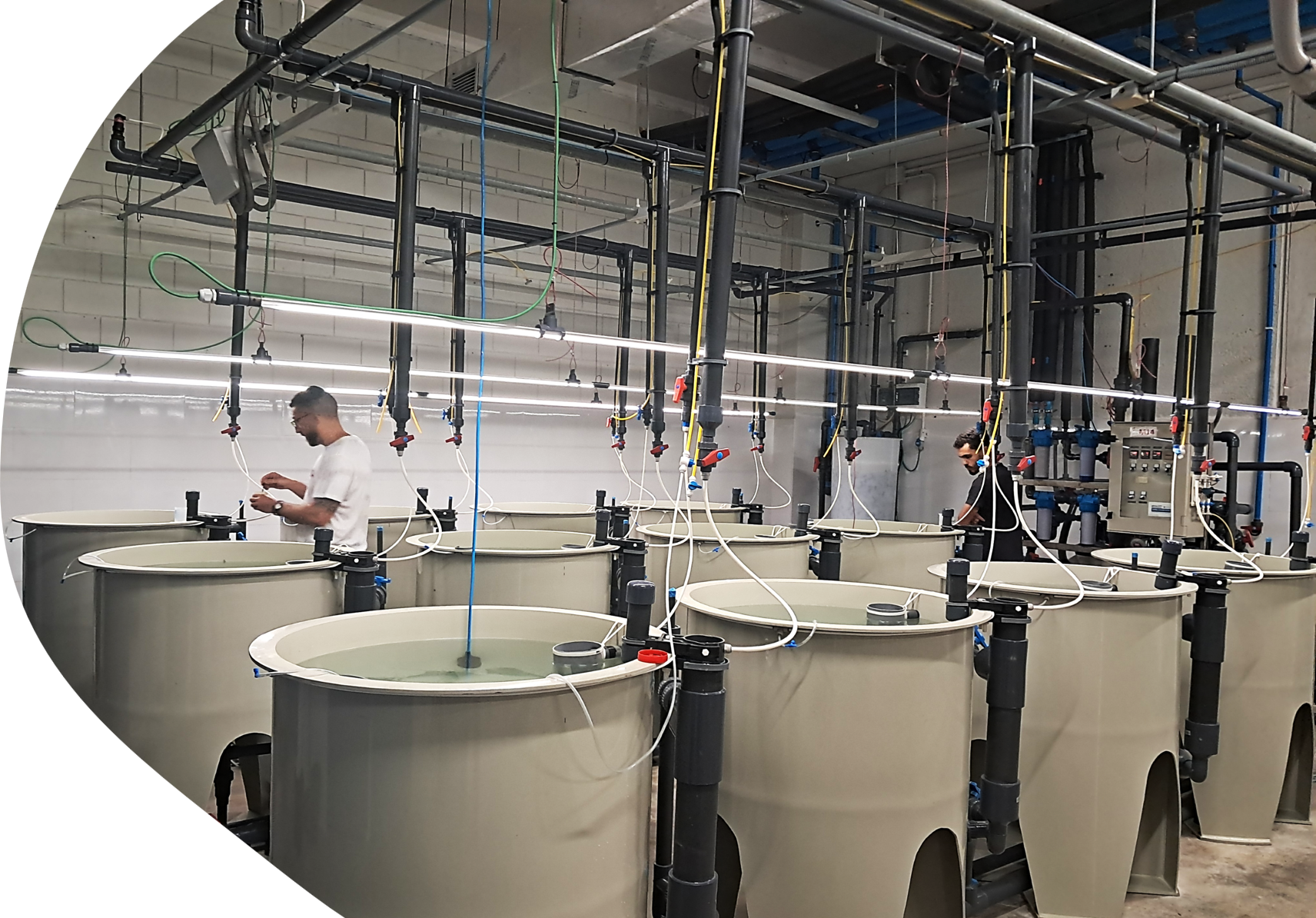
 At the heart of the new facility is IRTAmar®, IRTA’s own patented recirculating aquaculture system (RAS) technology, developed in-house by the institute’s engineers over more than two decades of hatchery operation. Unlike conventional flow-through systems, which draw continuously on external water sources, IRTAmar® recirculates and treats culture water within closed autonomous modules, filtering, oxygenating, and thermoregulating it in real time.
This matters enormously for larval work. Fish larvae require highly stable physicochemical conditions: temperature, salinity, dissolved oxygen, and water chemistry all need to sit within narrow windows, often independent of the season or the weather outside. Because IRTAmar® modules control their own water environment, researchers can maintain optimal, reproducible rearing conditions for any given species all year round, regardless of what is happening in the Delta outside the building. That reproducibility is what turns larviculture from a craft practiced by experienced hatchery technicians into a rigorous, data-driven science.
Automated environmental control
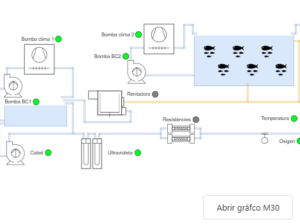 None of this would be practical without automation. Rather than relying on manual checks and adjustments, the unit’s IRTAmar® modules continuously monitor and regulate the culture water’s key parameters: temperature, dissolved oxygen, salinity, pH, and flow through networked sensors and actuators that respond in real time, day and night. When a value drifts outside its target range, the system corrects it automatically, without waiting for a technician to notice and intervene.
For larval rearing this is more than a convenience; it is a scientific necessity. Larvae are reared through a sequence of tightly timed developmental windows, and even a brief, unnoticed deviation in temperature or oxygen can shift hatching rates, feeding behaviour, or survival. Automated control turns environmental management from a reactive, labour-intensive task into a continuous, precise, and auditable process; freeing researchers to focus on the biological questions they came to answer, while the infrastructure quietly keeps conditions where they need to be, batch after batch, trial after trial.
Simulating tomorrow’s ocean: warming and acidification
The same automation that keeps culture water stable can also be turned the other way: instead of holding conditions constant, it can be programmed to reproduce the conditions the ocean is expected to face in the coming decades. The new unit incorporates the capability to run controlled “climate change simulation” scenarios, gradually raising water temperature or lowering pH, the two central, interlinked signatures of ocean warming and acidification, to levels projected under different climate trajectories.
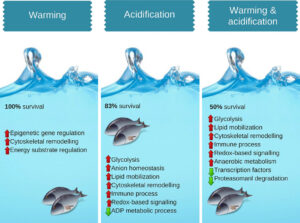
This is a capability with growing scientific urgency. IRTA’s own aquaculture researchers have been active contributors to the study of how rising temperatures and shifting ocean chemistry affect the physiology of farmed fish, crustaceans, and other aquatic organisms, and larval stages are typically among the most sensitive to exactly these stressors. By exposing larvae, juveniles, or broodstock to precisely controlled warming or acidification regimes, alone or in combination, researchers can observe, under fully replicable conditions, how growth, metabolism, skeletal development, and survival respond to the water chemistry a species may encounter later this century. That turns the facility into more than a production tool: it becomes a forward-looking laboratory for climate-change biology, helping identify which species and which life stages are likely to be most vulnerable, and informing the selective breeding and management strategies the aquaculture sector will need to adapt.
Security by design: biosecurity and traceability
Working with live aquatic organisms, often including broodstock imported from other institutions, or animals used in pathogen and vaccine trials, carries real biological risk. A single introduced pathogen can compromise an entire research line, or worse, escape into surrounding waters. The new larval rearing unit was therefore built around “high biosecurity and traceability” as core design principles, not afterthoughts bolted on later.
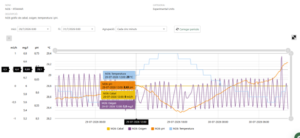 In practice, this means closed, filtered recirculation loops that physically separate research batches from the external environment; disinfection and quarantine protocols at every point where animals or water might move between systems; and continuous, automated monitoring of the physicochemical and biological parameters of the culture water. Every rearing unit generates a data trail: temperature curves, oxygen levels, feeding records, mortality events; that allows researchers to reconstruct exactly what conditions a given larval batch experienced from hatching onward. This is the same philosophy that underpins IRTA la Ràpita’s broader biosafety infrastructure, which already includes the largest Level 2 biosafety facility for aquatic organisms in Europe. The new unit extends that same rigor down to the larval scale, where contamination risks are hardest to control precisely because the animals themselves are so small and so numerous.
For external partners, companies developing vaccines, feeds, or genetic lines, for instance, this combination of biosecurity and traceability is what makes the facility usable for regulated or commercially sensitive trials, not just academic experiments.
A flexible platform for many species and many protocols
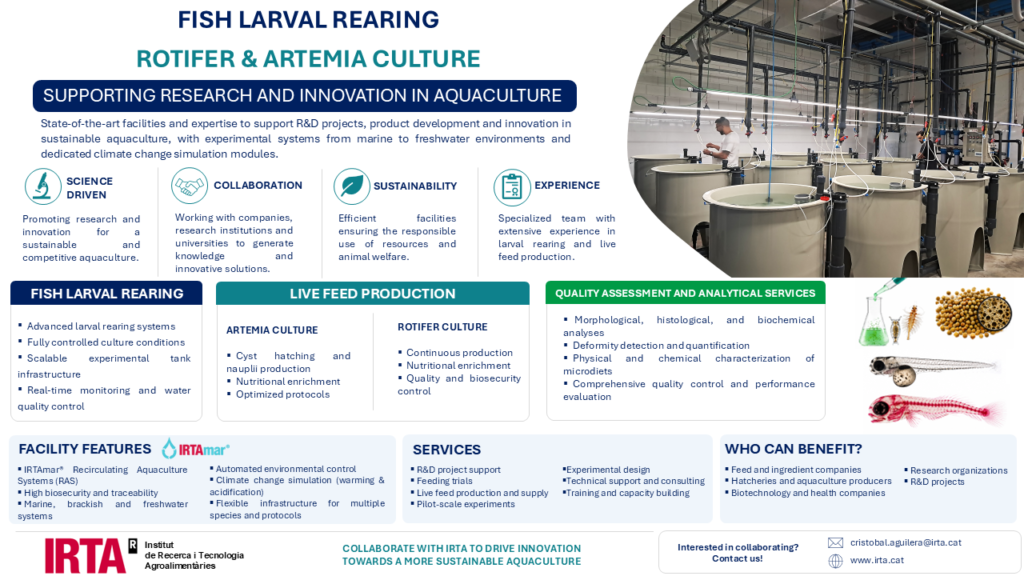
Because each IRTAmar® module is autonomous, with its own water treatment, monitoring, and control loop, the unit is not locked into a single production line or a single experimental design. Modules can be reconfigured relatively quickly to suit a new species, a new life stage, or a completely different research protocol, whether that means adjusting tank density and light regimes for a new candidate species for diversification, isolating a batch for a pathology or nutrition trial, or running several parallel treatments, different diets, temperatures, or stocking densities, side by side under otherwise identical conditions.
 This modularity is what allows a single physical building to serve a genuinely diverse research and innovation agenda: fish, and potentially other aquatic organisms, at different life stages, under different environmental treatments, for different institutional partners, all without one project’s requirements dictating the design of the whole facility. For a research centre, that translates into shorter turnaround times between projects; for external partners: companies, universities, or public agencies, it means the unit can be adapted to their specific protocol rather than the other way around.