
How to start a Biofilter
Ideally, your own facility should already have a mature biofilter so that you can recharge another biofilter, but if you do not have nitrifying bacteria, we will explain how to start from the very beginning.
As a rule, we will not introduce fish into our RAS until we are sure that our biofilter is sufficiently mature to accept the biomass it will receive.
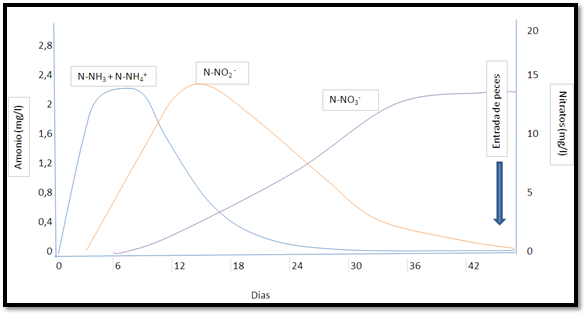
Under optimal conditions, the process in fresh water takes between 20 and 25 days, but in salt water the process usually lasts a month and a half, even with good temperature (20 -25ºC).
For each case we will calculate the amount of TAN (Total Ammoniacal Nitrogen (N-NH3 + N-NH4+)) that our batch of fish will generate on the first day of ingestion, for this we start from the following data:
- Total biomass on the day we introduce the fish (Kg)
- Feed percentage (%)
- Protein percentage of the feed we supply.
- K = Constant 0.092 comes from multiplying: 0.16 x 0.80 x 0.80 x 0.90
- There is 16% of N in the feed protein
- 80% of the Nitrogen is assimilated
- 80% of the assimilated Nitrogen is excreted
- 90% of the N is excreted as TAN and 10% as urea
PTAN (Daily TAN production) = ((X Kg feed / day) x (Y Kg protein/Kg feed) x (0.092 Kg TAN/Kg protein) x (106 mg/Kg) ) / (time = 1 day)
With this PTAN data (in g TAN / day) we can know what theoretical concentration of TAN we will have in our cultivation system, we only need to know the volume (in m3) of water in our system.
[TAN]=PTAN/Volume
This will be the value of the TAN concentration expressed in mg/l that our biofilter must eliminate on the first day.
If our RAS system has been well sized and we manage our mature biofilter properly, we will have no problem eliminating this TAN concentration throughout the day.
Therefore, we must prepare our biofilter so that it is able to eliminate this TAN contribution without any problem. As the fish grow and we increase the amount of feed in the system, our biofilter will be able to increase its cellular biomass to ensure the progressive increase in TAN that will occur until the day of harvest.
Obviously, even though we initially prepare a sufficient bacterial load to eliminate the TAN contribution that the fish will generate on their first day of feeding, our biofilter will have been previously sized taking into account the maximum food supply point of the cultivation cycle, which usually coincides with the point of maximum biomass of the culture (see section 6.10.) and we will reach the maximum occupancy point of the biofilter substrate gradually, day by day, thanks to the increase in food that will be made daily in the plant and which will be a function of the growth curve of our cultivated species and our cultivation conditions. When will we know that our biofilter is mature? When we add TAN to the system, using NH4OH or NH4Cl, equivalent to what our fish will add on the first day they are fed, we see that after 24 hours the concentration of TAN and Nitrites is 0.
To ensure the proper functioning and cell growth of our autotrophic bacteria (Nitrosomonas and Nitrobacters) in the biofilter, among other things, we must ensure an adequate supply of a source of Nitrogen and a source of inorganic Carbon in an aerobic medium. As a source of Nitrogen, our bacteria will use the nitrogen from the excretion of the fish and as a source of inorganic carbon, we can add, for example, sodium bicarbonate or calcium carbonate. By stoichiometry we observe that, for each kilo of feed supplied, we must provide approximately 250 – 400 g of sodium bicarbonate, in this way we will avoid our alkaline reserve falling to dangerous levels. Obviously, in fresh water we will be stricter than with sea water, since sea water already has naturally and due to its composition, a buffering power greater than that of fresh water.
A valid procedure to begin to mature our biofilter will be to make a known contribution of NH4OH or NH4Cl as a source of Nitrogen and another of sodium bicarbonate as a source of inorganic carbon. Wait a few days for the analysis and try to interpret where we are on the maturation graph.
We will not add another amount of NH4CL or NH4OH until the TAN value decreases. Gradually and following this pattern we will progressively add more Carbon and more Nitrogen to the system to keep our bacteria well fed.
It is difficult to generalize a specific protocol for biofilter maturation; each technician in his facilities must determine which is his best method, depending on his working conditions, handling, species, temperatures, etc.
Below is a real example from an IRTAmar® system at the IRTA facilities in la Ràpita:

The recirculation system in this example starts with a prior disinfection of all its components, including the biofilter, since the previous “guests” belonged to another species and different cultivation phase. Once the system has been disinfected (see disinfection section), it is filled with water, in this case salt water. It is not essential to fill all the cultivation tanks; we can leave most of them empty to save energy and subsequent cleaning work; it would be enough to leave 20% of the tanks full and recirculating.
The first step is to calculate, as explained above, the TAN Production that your fish will generate on the first day they feed. Once we know this data, we already know how much TAN we want our biofilter to be able to eliminate when our fish start eating. We will prepare our biofilter so that, when that day comes, the TAN and Nitrite levels are close to zero and feeding the fish will not be a problem.
In this example, we will use commercial ammonia (NH4OH) at 26% richness and density of approximately 1 g/cc as a source of nitrogen and sodium bicarbonate powder at approximately 100% richness as a source of carbon.
Initial biomass of 100 kg of fish at 1% feed, with a 45% protein content in the feed, doing the calculations:
P TAN = ( ( 1 kg feed / day) x (45 kg protein / kg feed) x (0.092 kg TAN / kg protein) x (106 mg / kg ) ) / (1 day) = 41.4 g TAN / day.
Stoichiometrically, one mole of TAN is equivalent to 1 mole of NH4OH, therefore:
(41.4 g TAN/day) x (1 mol TAN / 18 g TAN) x (1 mol NH4OH / 1 mol TAN) x (35 g NH4OH / 1 mol NH4OH) x (1 ml NH4OH/ 1 g NH4OH) x (100 ml commercial product / 26 ml NH4OH) = 309.62 ≈ 300 ml of commercial ammonia.
As for the carbon source, we will add 25% in the form of sodium bicarbonate in relation to the feed provided, therefore: 1 kg of feed x 0.25 = 250 g of sodium bicarbonate.
Both ammonia and bicarbonate will be added to the system in the expansion or header tank, preferably both sodium hydroxide and bicarbonate will be previously dissolved in a container with water from our own system, to ensure perfect homogenization and dissolution.