
Gas supersaturation in Aquaculture
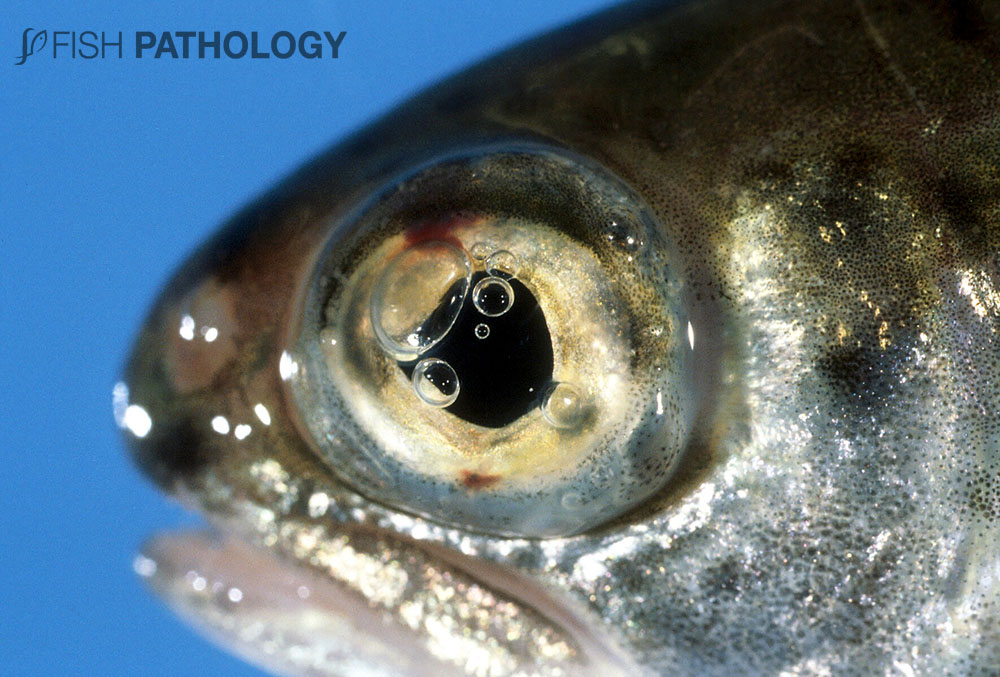
Supersaturation is a phenomenon that can cause several diseases in aquaculture, lethal or sublethal at all stages of cultivation. The best-known signs in fish are exophthalmia and bubbles are visible to the naked eye under the scales or fins. This phenomenon was first described by Gorham (1901).
Possible Causes of Bubble Disease
The existence of a pore in the suction area of a pump. When the pump is stopped and the system is full of water, we will see water coming out of the suction area of the pump. For this reason, when the pump is running it will suck in air, air that carries Nitrogen among other gases and that will dissolve in the water until supersaturation. It must be checked daily, it can be easily done if you take advantage of the module stop to clean filters, e.g.
The water can become supersaturated due to an increase in temperature because of the lower solubility of the gases. Therefore, monitor the systems that are kept at a warm temperature in winter.

How do we solve it?
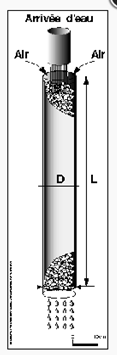
To eliminate supersaturation, we must promote the balance of gases dissolved with the air, therefore we will maximize the air/water contact surface. The best-known methods are waterfalls, surface aerators and shallow ones, ventilation columns or gravity degassing (like ours) whose only drawback is that if we had injected oxygen, we would lose some of it here.
A degassing column is nothing more than a tube full of bioballs, which will allow you to create a cascade and therefore a compensation with the atmosphere of the partial pressure of the gases. The minimum effective height of the column should be 1 meter and of a diameter sufficient to maintain 700 m / h of water flow rate.
Limits that we must not exceed. It is recommended as a rule when working with fish not to exceed:
- Larval culture: 102% TGP (or delta P + P with 15 atm of 760 mmHg)
- Fattening: 105% TGP (or DELTA P + P with 38 atm of 760 mmHg)
- Maintained levels of 103% TGP can produce a reduction in growth
- The best value is to be close to 100% TGP
- In bivalves, mortalities have been detected at 116 and 120% TGP
Tips in case of problems
- Do not reduce the water level in the pool, the fish will try to compensate for the supersaturation by going to the bottom of the tank, where the bubbles become smaller and therefore do less harm. Therefore, if you can even increase the height of the water column, the better. As an example: When you have 110% TGP on the surface at 1 meter depth you will have 100% TGP.
- If you can, do a gradual water change and cool the water a few degrees.
- Aerate the water from the surface.
- Check for possible leaks in the pump suction and fix them.
How to calculate N2
If someone wants to try to find the proportion of N2 gas instead of the indirect reading in TGP, they can do the following simple exercise: If we assume that dissolved CO2 and Ar are negligible at the time we can take the TGP and dissolved Oxygen readings to determine the dissolved N2.
- pO2 is the partial pressure of oxygen
- pN2 is the partial pressure of Nitrogen
- TGP(% sat ) = ( DO (% sat ) x 0.2095))+(N2 (% sat) x 0.7808))
- Isolating the N2