2025: A Pivotal Year for IRTAmar® RAS in Aquaculture
1) From “automated” to autonomous and recipe‑driven
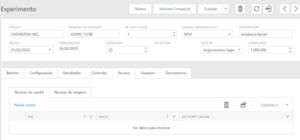
In 2025, IRTAmar® introduced an automated management layer enabling the scheduling of daily operational “recipes” (e.g., setpoints for temperature, recirculation flow, dissolved oxygen and pH) for each trial. The logic executes planned changes throughout the experiment—for example, stepping temperature from 24 °C to 23 °C and then 22.5 °C—without manual intervention, while maintaining real‑time control and alarms. This brings best‑practice process control to RAS operations and allows experimental workflows to be structured with high reliability.
Beyond setpoint management, the IRTAmar® web application provides module visualisation, alarms, historical data in table/graph formats, and segmented access for external clients who monitor their trials remotely—with data isolation and project‑level anonymisation—reinforcing security and transparency.
2) Control Research: full digitalisation of the experimental cycle
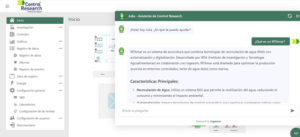
The IRTA–Ingesom collaboration consolidated in 2025 with Control Research becoming the digital core of the platform: it monitors the facility and modules, enables remote operation, manages end‑to‑end trials, captures real‑time data, and integrates preventive/corrective maintenance planning (CMMS) within the same application. This evolution positions IRTAmar® as a service platform rather than a conventional RAS, unifying operations, data and maintenance on a patented foundation (ES2387245) with a single web interface.
The prior work with Ingesom on the master SCADA—with centralised alarm management (oxygen, temperature, flow, pH, TDG), energy logging and web‑based consultation—provided the basis for the standardisation of RAS variables at facility scale (pump rooms, tanks, sample preservation chambers). In 2025, this architecture matured into a “plant layer” that communicates natively with Control Research.
3) Traceability and primary data: from laboratory practice to certification
Since its inception, IRTAmar® has prioritised full traceability of physicochemical and operational parameters to support certification and auditing requirements. In 2025 this commitment was reinforced through the unification of data capture, alarms and recipes within a single platform, ensuring continuous, reproducible primary datasets that facilitate technology transfer and industrial scale‑up.
4) 2025 Biosecurity Use Case: IRTAmar® installation at HIPRA
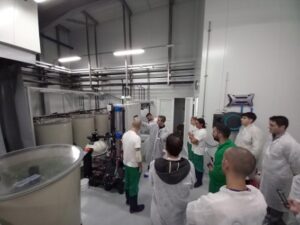 A major milestone in 2025 was the acquisition and installation of an IRTAmar® system at HIPRA’s facilities (Amer, Girona) for high‑security biological trials. The deployment demonstrates spatial adaptability (design matched to the available footprint), efficient use of marine water indoors (>50 km from the coast), and optimised energy performance and maintainability. The objective: to strengthen R&D in vaccines under the highest standards of stringency and quality.
The system provides precise control of physicochemical and biological conditions, supports both freshwater and seawater, and delivers data for more efficient production decisions; in practice, it brings the rigour of controlled trials into BSL environments with stringent robustness and redundancy requirements.
5) Service layer and ecosystem: 2025 exhibitions and dissemination
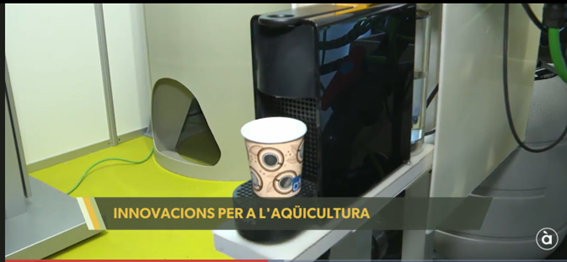
In 2025, IRTAmar® showcased these capabilities at AquaFuture Spain (Vigo), highlighting the new recipe‑driven management layer and secure access for research clients monitoring ongoing trials. Sector‑wide coverage reinforced its positioning as a “Smart RAS in aquaculture” and the IRTA–Ingesom partnership as a sustained public–private model.
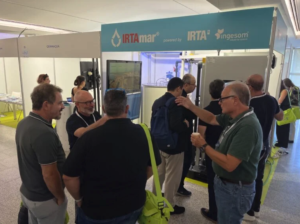
Valencia became the European capital of aquaculture during Aquaculture Europe 2025, a congress bringing together over 3,000 experts, 200 exhibitors and hundreds of scientific contributions—the largest edition to date.
Within this international setting, IRTA played a leading role, and the IRTAmar® platform, developed with Ingesom, was central to technological demonstrations. One of the major innovations presented was the expanded sensor layer, capable of capturing a wider range of experimental variables with greater precision.
Another highlight was the launch of the first AI application within IRTAmar®, focused on:
- Advanced interpretation of experimental data
• Prediction of aquaculture crop performance
• Automatic optimisation of environmental variables
This AI layer enhances robustness, reliability and predictive capability while preserving the scientific traceability that defines the platform.
6) What changes for researchers and RAS operators?
a) Reproducible experimental design
- Definition of scheduled setpoint curves (temperature, pH, DO, flow) at trial start, with automated execution and contextualised alarms. Outcome: less intervention, lower variability and higher statistical power.
b) Data‑assisted operations
- Dashboards with historical data, trends and module comparisons; export tools for analysis and audit. Centralised alarms with event traceability and energy data to assess experimental cost per unit time.
c) Governance and secure access
- Project‑based profiles for external clients who consult trial status, trial day and variable evolution in real time, with data isolation and permission control.
d) Maintainability and operational continuity
- Integrated CMMS (preventive/corrective) linked to RAS assets and alarm signalling, closing the detection–intervention–verification loop within the same platform.
7) Sectoral impact: from smart research to smart production
 The 2025 evolution of IRTAmar® highlights a clear trajectory: transforming the RAS into a digital, certifiable and scalable platform capable of operating in research centres and in production or biosecurity environments. The “integrated platform” narrative (beyond equipment) and comprehensive traceability support knowledge transfer and reduce time‑to‑scale for new species or protocols.
Conclusions and 2026 Roadmap
- Recipes + SCADA + CMMS have turned IRTAmar® into a unified operational layer for R&D and pilot‑scale production. The HIPRA deployment validates robustness, modularity and water/energy efficiency under extreme operational requirements.
- Controlled access for external clients accelerates public–private collaboration and provides data transparency—a key differentiator from traditional RAS.
- Natural next steps: enhanced analytics on historical data (e.g., consumption prediction models), energy optimisation based on hourly pricing, and multi‑module orchestration with real‑time automatic risk balancing (biosecurity) within the same architecture.